
The last post built ParkPulse: a single-file HTML prototype, encrypted with StaticCrypt, deployed to GitHub Pages behind a password. This post shows how to update that same site with one prompt.
The file on GitHub Pages is AES-encrypted ciphertext, so it cannot be edited in place. The workflow is: clone the repo, decrypt the HTML, edit, re-encrypt with the same password, commit, push.
What you need
The live site from the first post (or any StaticCrypt-encrypted site on GitHub Pages)
A paid Claude account with the Claude desktop app and Cowork mode enabled
A GitHub Personal Access Token with write access to the repo (see the previous post if you have not set this up)
The prompt
I opened Cowork and pasted this:
I have a live site at nealvybe.github.io/parkpulse-proto that's encrypted
with StaticCrypt (password: pulse2026). The source repo is
github.com/nealvybe/parkpulse-proto. Clone the repo, decrypt the index.html,
and add an "About" page to the top navigation menu. The About page should
describe ParkPulse as a product: what it does, who it's for, and a short
team section with three fictional team members (names, roles, one-line
bios). Match the existing design style and orange accent color. After the
edit, re-encrypt with StaticCrypt using the same password, commit, and
push to GitHub so the live site updates.
The prompt contains everything Cowork needs: the live URL, the password, the repo, the change, and the deploy instruction.
What Cowork did
Step 1: Clone. Standard git clone. The repo contained the encrypted index.html (99KB) and a README.
Step 2: Decrypt. First error. StaticCrypt’s decrypt command failed because the repo had no .staticrypt.json config file. That file stores the salt used during encryption. Without it, the decryptor cannot reverse the process.
Claude solved this by reading the encrypted HTML directly. The StaticCrypt config object is embedded near the bottom of the encrypted output, including the salt:
"staticryptSaltUniqueVariableName":"515fd507a794550948cb85bd91e23474"Claude extracted that value and passed it to the decrypt command explicitly. The original 825-line prototype came back intact.
Step 3: Edit. Claude modified three parts of the decrypted file:
An
Aboutlink added to the navigation barA block of CSS for the About page (hero, feature grid, team grid, avatar circles, responsive breakpoints)
The About view HTML: product description, audience paragraph, three team member cards
The existing showView() function did not need changes. It was already written to match view names to element IDs dynamically, so adding a new view only required adding the HTML with the right ID. The file went from 825 lines to 988 lines — 163 lines added.
Step 4: Re-encrypt. Same password, same StaticCrypt command. The 988-line source became a 112KB encrypted file.
Step 5: Commit and push. Second error. The bare git push failed because Cowork’s sandbox has no stored GitHub credentials. This is the same issue from the first deployment. Claude authenticated by embedding the Personal Access Token in the push URL. Because the token already had write access to parkpulse-proto from the previous session, the push succeeded on the first authenticated attempt.
Step 6: Verify. GitHub Pages redeployed in 36 seconds. Claude loaded the live URL, entered the password, and confirmed the About page rendered. I refreshed the site, typed pulse2026, and saw four nav items instead of three.
What the About page contains
Three sections, matching the existing design:
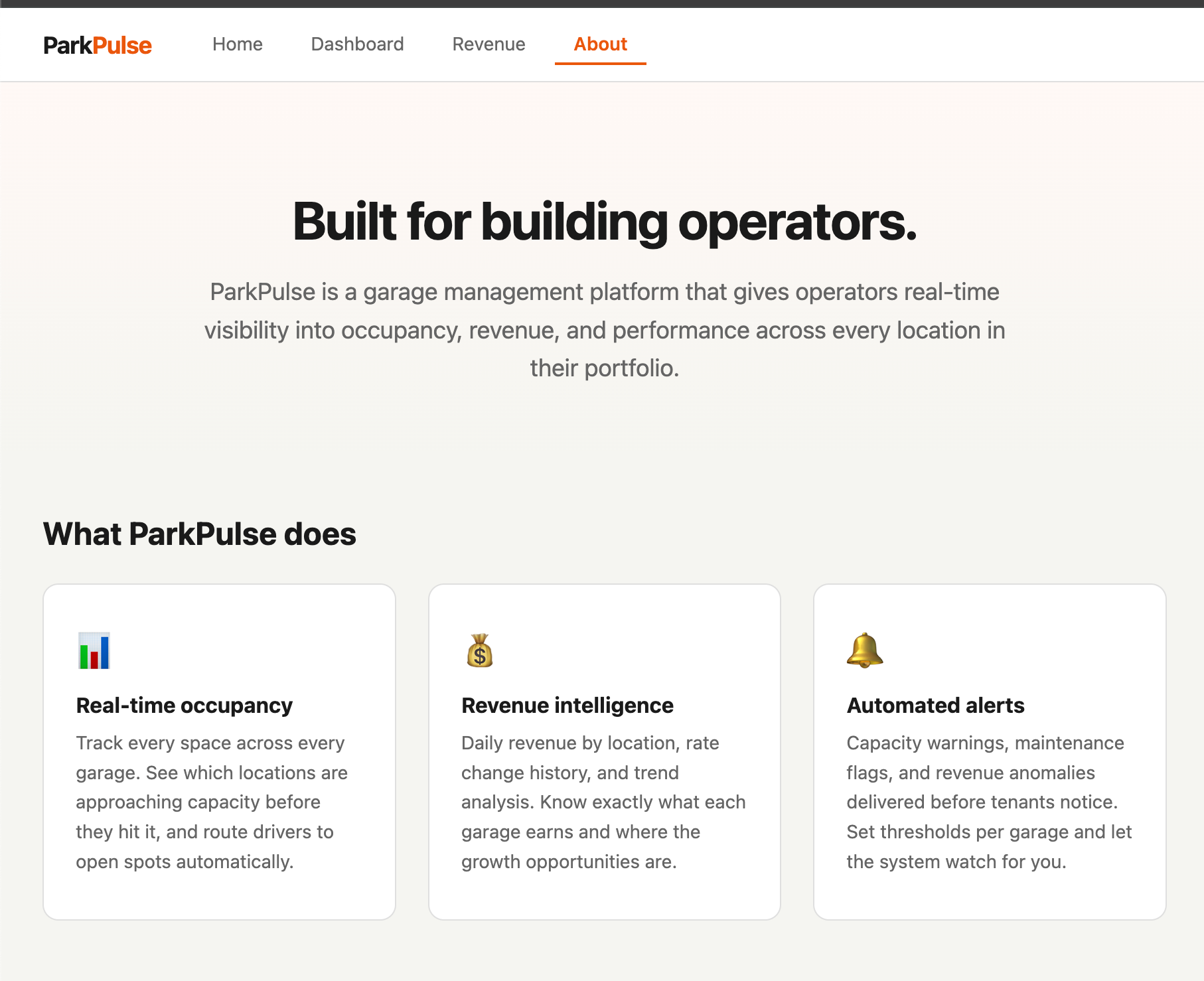
A hero with the headline “Built for building operators” and a product summary
A feature grid (real-time occupancy, revenue intelligence, automated alerts) reusing the landing page’s card style
An audience section naming the three target segments: commercial real estate operators, property management firms, municipal parking authorities
A team section: three fictional team members — Maya Reeves (Co-founder and CEO), James Kowalski (Co-founder and CTO), Sofia Patel (Head of Product) — with orange avatar circles, roles, and one-line bios
Home, Dashboard, Revenue, and About all navigate correctly. Same password, same URL.
What was different from the first deployment
The first deployment required one manual fix: scoping my GitHub token to the new repo. This update required zero manual actions because that setup carried over. Two errors came up during the run (missing salt config, missing git credentials), and Claude resolved both without prompting me.
Total time from pasting the prompt to verifying the update: under five minutes.
Try it
Live site: nealvybe.github.io/parkpulse-proto (password:
pulse2026)
Neal Foster is Co-Founder & CTO of SportChartz and Founder & Partner of Vybe Capital.