
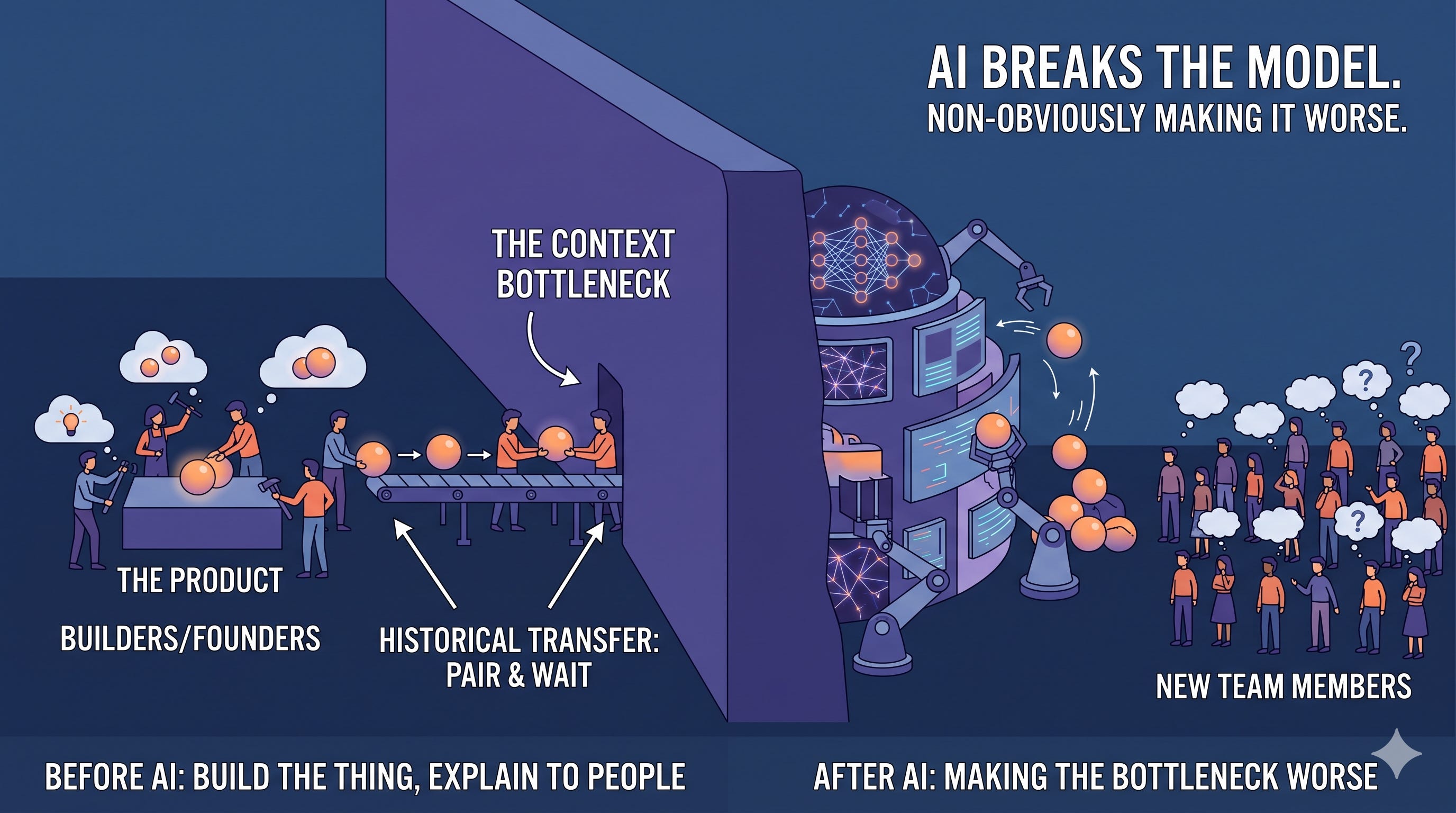
Every company that scales past a handful of people hits the same wall. The people who built the thing have to stop building and start explaining.
This has always been the bottleneck. Not hiring. Not fundraising. Not product-market fit. The bottleneck is the transfer of context from the people who have it to the people who need it. And for most of the history of building companies, the answer has been some version of: hire smart people, pair them with experienced people, and wait.
AI is about to break this model. Not by solving the training problem - by making it worse in ways that aren’t obvious yet.
How training actually works
The official version is onboarding docs, wiki pages, recorded walkthroughs, maybe a buddy system. The real version is someone sitting next to someone else for a few weeks and absorbing how decisions get made. What to prioritize. What to ignore. Which shortcuts are fine and which ones create problems downstream.
This works because the new person makes small mistakes, gets corrected in context, and builds a mental model of how the organization thinks. The feedback loop is tight. The cost of mistakes is low because the scope starts small.
The whole thing depends on experienced people having time to do the correcting. And it depends on mistakes being visible enough to catch.
What AI changes
When someone uses AI to produce work - code, documents, analyses, designs - the output looks finished. It’s syntactically correct. It follows conventions. It reads like someone who knows what they’re doing wrote it.
This is the problem. A junior person producing work with AI assistance looks a lot like a mid-level person producing work without it. The visible quality gap that used to signal “this person needs more guidance” has compressed. The work looks right even when the person producing it doesn’t fully understand why it’s right.
In a code review, the difference between code written by someone who understands the system and code written by someone who prompted their way to a working solution used to be obvious. Variable naming, edge case handling, architectural choices - these things revealed how deeply someone understood what they were building. Now the AI handles all of that. The code looks clean. It passes tests. But the person who submitted it might not be able to explain why this approach was chosen over an alternative, or what breaks if the assumptions change.
The review bottleneck
Code review has always been the last line of defense. Someone experienced reads the work, spots the gaps, and either fixes them or sends it back. This worked when the volume was manageable and the patterns were recognizable.
AI-assisted development changes the math. A developer using AI tools can produce three to five times the volume of code in the same time. The reviewer’s job just got three to five times harder, and the mistakes are three to five times harder to spot because the surface-level quality is high.
The reviewer used to scan for obvious problems - style issues, missing error handling, inefficient patterns. Those are gone now. The AI handles them. What’s left are the subtle problems: wrong abstractions, misunderstood requirements, solutions that work for the current case but create tech debt for the next three cases. These take real expertise to spot, and they take time to explain.
So the people with the most context are now spending more time reviewing more output that’s harder to review. The training bottleneck didn’t get better. It got worse.
The delegation paradox
Here’s where it gets counterintuitive. AI makes individuals more productive, which should mean you can do more with fewer people. And in the short term, that’s true. A small team with AI tools can ship at a pace that would have required a much larger team three years ago.
But you still need to grow the team eventually. Markets move, products expand, and the people who built the first version can’t do everything forever. When it’s time to scale, you discover that the training infrastructure has atrophied. The experienced people have been heads-down shipping. The documentation reflects what the AI generated, not the reasoning behind it. The institutional knowledge is concentrated in fewer heads than ever.
This is the paradox: the same tools that let you move fast with a small team make it harder to grow that team later. The speed advantage creates a training debt that compounds over time.
It’s not just engineering
This pattern shows up everywhere AI touches knowledge work. A junior analyst using AI to produce financial models creates output that looks polished but might not reflect a deep understanding of the assumptions. A junior marketer using AI to write campaigns creates copy that reads well but might miss the strategic positioning that an experienced person would catch.
In each case, the visible output improves while the invisible understanding stays the same. And the experienced people who could close that gap are busier than ever because the volume of output to review has exploded.
Product management hits this too. An AI can generate a reasonable-looking PRD from a prompt. But a PRD that covers the right features, has the right scope, and makes the right tradeoffs requires understanding the customer, the market, and the technical constraints in a way that doesn’t transfer through prompting.
What I’m watching for
There’s no clean answer to this yet. The training problem has been hard for as long as companies have existed. AI is reshaping it, not solving it.
The companies that figure this out will probably find ways to make the reasoning visible, not just the output. Some version of showing your work that scales beyond “explain your code in a pull request description.” Something that captures why decisions were made, not just what was decided.
The ones that don’t figure it out will build fast, ship fast, and then stall when the original team burns out and no one else can pick up where they left off. The training debt comes due the same way tech debt does - gradually, then suddenly.
I think about this a lot because I’m building a company right now where the AI-to-human ratio in the development process is high. The leverage is real. But so is the risk that the knowledge stays in too few heads for too long.
Neal Foster is Co-Founder & CTO of SportChartz and Founder & Partner of Vybe Capital.